Abstract
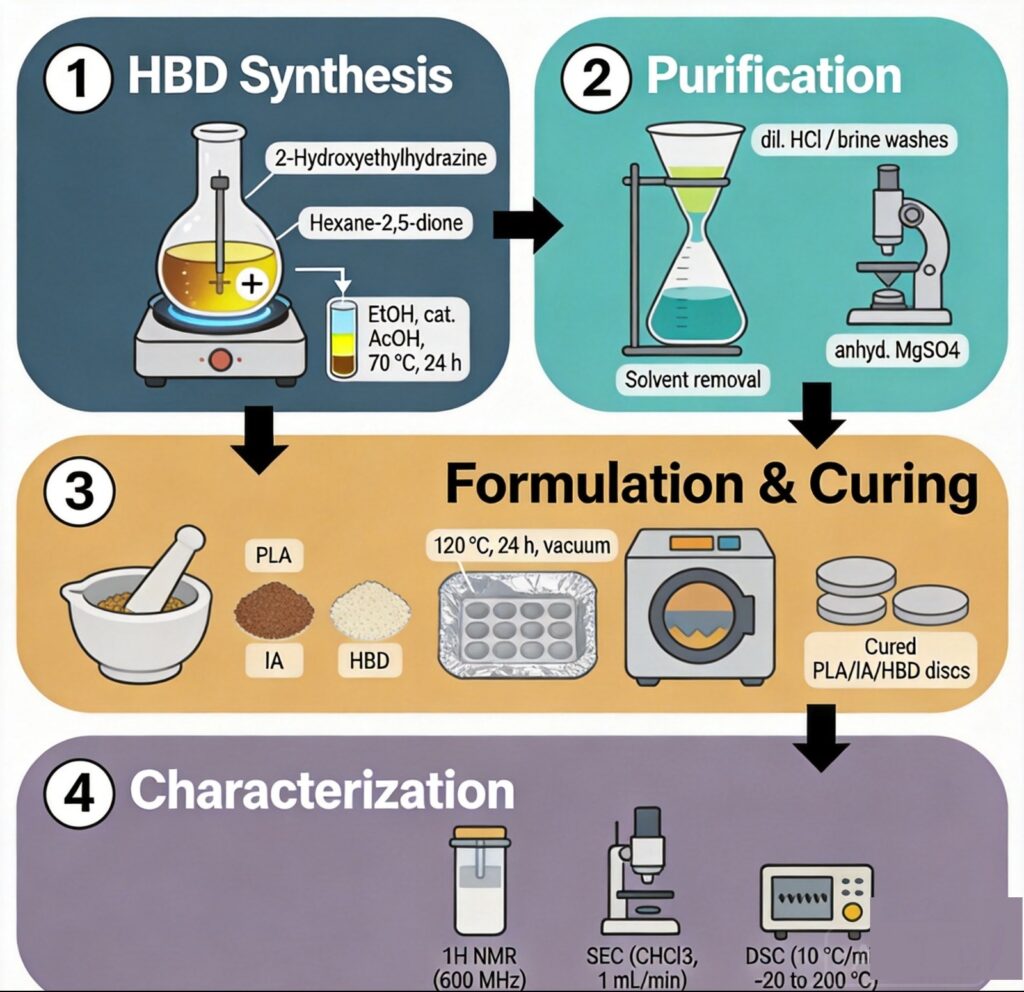
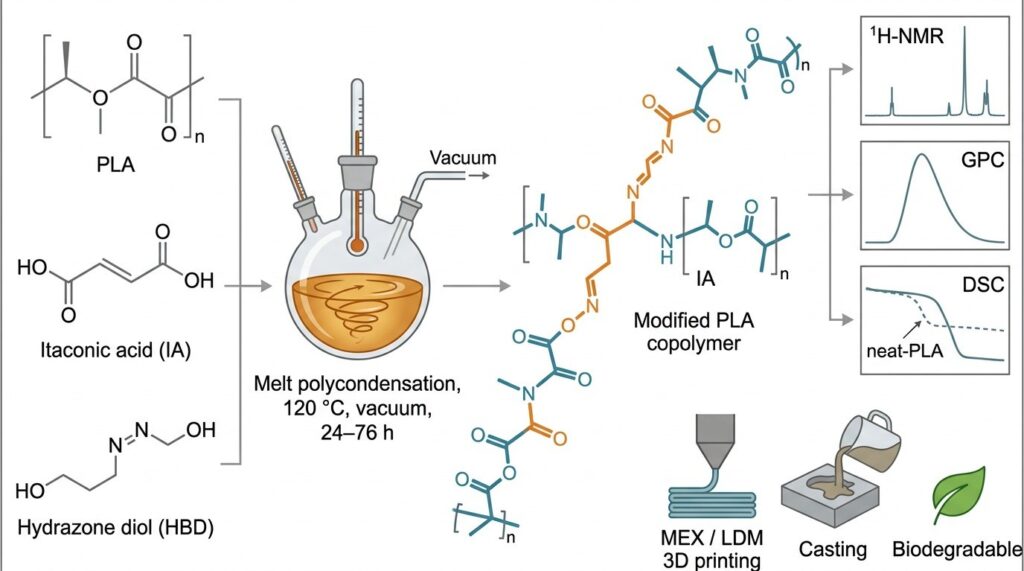
The growing demand for sustainable alternatives to conventional polymers has driven research into biodegradable composite materials for advanced manufacturing. In this study, poly (lactic acid) (PLA)-based systems containing itaconic acid (IA) and a hydrazone-bearing diol (HBD) were prepared through melt-polycondensation under vacuum at 120 °C. The synthesized materials were developed as potential matrices for bio-based composites intended for casting and Material Extrusion (MEX) applications.
A series of formulations with different PLA molecular weights, IA contents and diol concentrations were investigated. The effect of prolonged thermal treatment (24 and 76 h) on the resulting polymeric systems was evaluated. Structural and physicochemical characterization was performed using 1H nuclear magnetic resonance spectroscopy (¹H-NMR), gel permeation chromatography (GPC) and differential scanning calorimetry (DSC).
The results demonstrated significant differences in molecular weight distribution among the samples investigated. GPC analysis revealed broad molecular weight distributions for the IA-containing systems, suggesting the formation of heterogeneous polymeric structures. DSC measurements indicated modifications in the thermal behavior of the materials compared to neat PLA, with changes in glass transition temperature associated with the incorporation of IA and diol components. NMR analysis confirmed the presence of PLA structural units and provided evidence of compositional differences among the synthesized formulations.
Overall, the study demonstrates that thermal treatment of PLA in the presence of IA and hydrazone-bearing diols produces structurally modified polymeric systems with formulation-dependent molecular and thermal characteristics. These preliminary findings provide valuable insight into the synthesis of bio-based polymer matrices intended for sustainable composite fabrication by means of casting and Material Extrusion (MEX).